

Your Complete Guide to Reading 1960s–1970s Chinese Web Novels
The era of ration coupons, sent-down youth, and revolutionary slogans — decoded.
If you’ve ever picked up a Chinese web novel set in the 1960s or 1970s and found yourself drowning in production brigades, grain tickets, and struggle sessions, you’re not alone. This genre — known as 年代文 (niándài wén), literally “era fiction” — is one of the most beloved categories of Chinese online literature. Stories are set against the backdrop of the Mao era, often featuring a modern woman reborn into a peasant village, a rusticated city girl making the best of countryside life, or a clever heroine navigating the politics of a military compound.
The problem? These novels assume a level of historical knowledge that even many Chinese readers under 40 don’t have — let alone international readers. This guide gives you everything you need: historical context, essential vocabulary, political slang, and common plot tropes. By the end, you’ll be reading 年代文 like you lived through it yourself.
Table of Contents:
- The Historical Backdrop
- The Class System
- Political Vocabulary
- The Educated Youth
- Rural Life Vocabulary
- The Rationing System
- Everyday Life Vocabulary
- Revolutionary Culture & Objects
- Web Novel Tropes
- Quick Reference Glossary
- A Final Note
The Historical Backdrop
Understanding the setting is everything. 年代文 typically spans three overlapping historical periods.

The Three Hard Years (三年困难时期, 1959–1961)
The catastrophic aftermath of Mao’s Great Leap Forward (大跃进, Dà Yuè Jìn) — a campaign that forced peasants to abandon farming in favor of steel production, collectivize all land, and report wildly inflated harvest numbers to the state. The result was one of history’s deadliest famines, killing an estimated 15–55 million people. Many 年代文 stories set in the early 60s reference chronic hunger, food rationing, and the memory of starvation as a permanent psychological wound in the characters.
The Cultural Revolution (文化大革命, Wénhuà Dà Gémìng, 1966–1976)
Launched by Mao Zedong in 1966, the Cultural Revolution turned Chinese society upside down for a decade. Schools and universities were shut down. Intellectuals, “class enemies,” and anyone deemed insufficiently revolutionary were publicly denounced, humiliated, sent to labor camps, or killed. Red Guards (teenage revolutionary zealots) ransacked homes, burned books, and destroyed temples. The Party apparatus collapsed into chaos. This is the most common backdrop for 年代文 — it explains the fear, suspicion, political performance, and social upheaval that permeates these stories.
The Sent-Down Youth Movement (上山下乡运动, Shàngshān Xià Xiāng Yùndòng, 1968–1980)
In 1968, Mao declared that urban youth must go to the countryside to be “re-educated by the peasants.” Over the next twelve years, approximately 17 million young people were uprooted from their city homes and sent to rural villages, remote farms, and border regions across China. These were the 知青 (Zhīqīng) — Educated Youth, and their story is the beating heart of the 年代文 genre.
The Class System — The Most Important Thing to Understand
In Mao’s China, your class background (阶级成分, jiējí chéngfèn) was your destiny. It determined whether you could get a job, attend school, join the Party, marry well, or be publicly targeted. Characters in 年代文 think about class status constantly — it is the lens through which every interaction is filtered.
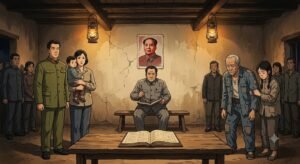
The Five Red Categories (红五类, Hóng Wǔ Lèi)
These are the “good” class backgrounds — revolutionary and trustworthy:
| Chinese | Pinyin | Meaning |
|---|---|---|
| 贫农 | Pín nóng | Poor peasant |
| 下中农 | Xià zhōng nóng | Lower-middle peasant |
| 工人 | Gōngrén | Industrial worker |
| 革命干部 | Gémìng gànbù | Revolutionary cadre |
| 革命军人 | Gémìng jūnrén | Revolutionary soldier (or their family) |
Being from a “red” family was a ticket to privilege — Party membership, university recommendations, factory jobs, and social safety.
The Five Black Categories (黑五类, Hēi Wǔ Lèi)
These are the targets of the revolution — automatically suspect, permanently disadvantaged:
| Chinese | Pinyin | Meaning |
|---|---|---|
| 地主 | Dìzhǔ | Landlord |
| 富农 | Fù nóng | Rich peasant |
| 反革命分子 | Fǎn gémìng fènzǐ | Counter-revolutionary |
| 坏分子 | Huài fènzǐ | Bad element |
| 右派 | Yòupài | Rightist |
Children of black-category families — even those born after land reform — inherited their parents’ stigma. A heroine with a “bad” family background (黑色成分, hēisè chéngfèn) faces enormous obstacles and must constantly prove her loyalty to survive. This is an incredibly common plot device in 年代文.
Key Class-Related Terms
成分 (chéngfèn) — Class background/status. Characters will ask “你成分怎么样?” (“What is your class background?”) before any significant social interaction. A clean background (清白的成分) is a valuable social asset.
根红苗正 (gēn hóng miáo zhèng) — Literally “red roots, upright sprouts.” Describes someone with an impeccably revolutionary family background. The ideal pedigree.
帽子 (màozi) — Literally “hat.” A political label forcibly placed on someone: “wearing the hat of a rightist” (戴右派帽子). Having a “hat” removed (摘帽子, zhāi màozi) was a significant relief.
摘帽子 (zhāi màozi) — To have one’s political label removed, to be rehabilitated.
划成分 (huà chéngfèn) — The process of officially assigning a family’s class status, done during land reform in the late 1940s–50s. The consequences echoed for decades.
Political Vocabulary — The Revolution in Words
Year after year of political campaigns produced a dense vocabulary of slogans, movements, and rituals. Here are the terms you’ll encounter constantly:
Campaigns & Movements
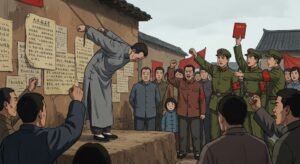
批斗会 (pīdòu huì) — Struggle session. One of the most terrifying features of the Cultural Revolution. A person accused of being a “class enemy” was forced to stand before a crowd, bow their head, and endure hours of shouting accusations and sometimes physical beatings from fellow villagers, coworkers, or even family members. Many people died or were driven to suicide by these sessions. In 年代文, the threat of a struggle session hangs over any character with a complicated background.
大字报 (dàzìbào) — Big-character poster. Hand-written political accusation posters pasted on walls in public spaces, used to denounce enemies. Characters in 年代文 live in fear of having their name on one.
运动 (yùndòng) — Campaign/movement. The CCP governed through a constant series of political campaigns. Characters must navigate each new “运动” carefully.
破四旧 (pò sì jiù) — Destroy the Four Olds (old customs, old culture, old habits, old ideas). A Cultural Revolution slogan used to justify the destruction of temples, antiques, books, and anything associated with pre-revolutionary China.
People & Roles
红卫兵 (Hóngwèibīng) — Red Guards. Teenage and young adult revolutionary zealots who formed Mao’s shock troops during the early Cultural Revolution. Armed with Quotations from Chairman Mao (the Little Red Book), they carried out public denunciations, ransacked homes, and terrorized “class enemies.” A Red Guard character in 年代文 is often portrayed as either a threat or — if it’s the heroine — someone who must perform revolutionary zeal while secretly protecting their family.
走资本主义道路当权派 (zǒu zīběnzhǔyì dàolù dāngquánpài) — “Capitalist roaders in power.” Usually shortened in conversation to 走资派 (zǒuzī pài). A label applied to Party officials deemed insufficiently radical. Being called this was extremely dangerous.
臭老九 (chòu lǎo jiǔ) — “Stinking ninth category.” A contemptuous term for intellectuals — teachers, professors, scientists, doctors. During the Cultural Revolution, intellectuals were ranked lowest in a hierarchy of enemies. A parent who is a “臭老九” brings enormous shame and danger to a family in 年代文.
革命委员会 (gémìng wěiyuánhuì) — Revolutionary Committee. Replaced the regular government and Party apparatus during the Cultural Revolution. These committees ran factories, schools, and villages. The head of the 革委会 is often a key power figure in 年代文.
赤脚医生 (chìjiǎo yīshēng) — Barefoot Doctor. Minimally trained rural health workers who provided basic medical care in villages. A surprisingly common role for a 年代文 heroine to take on, since medical knowledge from a “past life” translates well.
干部 (gànbù) — Cadre. Any government or Party official. Used very broadly — even the village accountant is a 干部 of sorts. “干部子弟” (gànbù zǐdì) — cadre children — had significant privileges.
Phrases You’ll Read Constantly
接受贫下中农的再教育 (jiēshòu pín-xià-zhōng-nóng de zài jiàoyù) — “To receive re-education from the poor and lower-middle peasants.” The official justification for sending educated youth to the countryside. Used both sincerely (by true believers) and sarcastically.
为人民服务 (wèi rénmín fúwù) — “Serve the people.” One of Mao’s most famous quotations, endlessly repeated. Characters are expected to invoke this phrase to justify any sacrifice.
革命不是请客吃饭 (gémìng bùshì qǐngkè chīfàn) — “Revolution is not a dinner party.” A famous Mao quote meaning revolution requires ruthlessness. Used to justify harsh actions.
提高警惕 (tígāo jǐngtì) — “Raise your vigilance.” A constant political exhortation — stay alert for enemies.
The Educated Youth (知青) — The Genre’s Heart
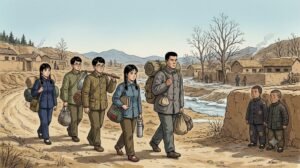
The 知青 (Zhīqīng) experience is so central to 年代文 that the entire genre is sometimes called 知青文 or 下乡文. Understanding this world is essential.
下乡 (xià xiāng) — Going down to the countryside/rustication. The act of being sent away.
插队 (chā duì) — To be inserted into a production team. The most common form of rustication — a group of educated youth is assigned to an existing village and must live and work with the peasants, as opposed to being placed in a separate farm.
知青点 (zhīqīng diǎn) — The quarters where sent-down youth lived, usually a shared dormitory on the edge of the village.
扎根农村 (zhā gēn nóngcūn) — “To take root in the countryside.” The political ideal — educated youth who declared they would stay permanently in the village and never return to the city. In 年代文, a heroine who publicly pledges to “扎根” is performing a dangerous sincerity she may or may not mean.
回城 (huí chéng) — Returning to the city. The consuming dream of most educated youth. The routes back: getting recruited as a factory worker (招工, zhāo gōng), being recommended for university (推荐上大学), marrying a local with urban connections, or simply waiting for policy changes. A central tension in many 年代文 plots.
招工 (zhāo gōng) — Worker recruitment. When a factory came to a village looking for new workers, this was a golden opportunity to escape. Spots were scarce, highly political, and subject to corruption and favoritism. Major drama potential.
推荐上大学 (tuījiàn shàng dàxué) — Being recommended to attend university. After the Cultural Revolution closed universities, a small number reopened in 1970–1971 admitting “Worker-Peasant-Soldier Students” (工农兵大学生, gōng-nóng-bīng dàxuéshēng). Places were allocated by political recommendation, not academic merit — a system rife with bribery and sexual exploitation. Another major plot point.
探亲假 (tànqīn jià) — Home visit leave. Educated youth were granted limited leave to visit their families in the city. The waiting, the paperwork, the train journey home — described in loving detail in many 年代文.
介绍信 (jièshào xìn) — Letter of introduction. Without one, you couldn’t travel, buy a train ticket, stay in a guesthouse, or conduct official business. The letter of introduction was the social lubricant of the era and appears constantly in 年代文.
Rural Life Vocabulary — The Commune System
Life in the countryside was organized through a rigid administrative hierarchy established by collectivization in the late 1950s.
The Three-Tier System
人民公社 (Rénmín Gōngshè) — People's Commune
         ↓
大队 (Dàduì) — Production Brigade
         ↓
生产队 (Shēngchǎn Duì) — Production Team
人民公社 (rénmín gōngshè) — People’s Commune. The top-level collective unit, roughly equivalent to a township. Ran schools, clinics, and administered Party policy. The commune secretary (公社书记) was a powerful local figure.
大队 (dàduì) — Production Brigade. A village or group of villages within a commune. Had its own Party branch, a militia, and sometimes a small industry. The brigade head (大队长, dàduì zhǎng) and Party secretary (支部书记, zhību shūjì) are frequent antagonists or mentors in 年代文.
生产队 (shēngchǎn duì) — Production Team. The basic unit of daily labor. Typically 20–40 households. Members worked together, shared tools, and split the collective income. The 队长 (duì zhǎng) — team leader — directly managed the educated youth and decided their work assignments.
Work Points (工分 Gōngfēn)
One of the most important concepts in rural 年代文. Under the commune system, peasants didn’t earn wages. Instead, every day of labor earned 工分 (gōngfēn) — work points. At year’s end, the team’s total income (from selling grain to the state) was divided by the total work points to calculate each point’s value. Your grain allocation and cash payout depended entirely on your accumulated points.
A strong adult male typically earned 10 工分 per day. Women usually earned 7–8 points. Educated youth, considered unskilled urbanites, often started at lower rates. A heroine who fights for equal work points, or who uses her skills (medical, accounting, sewing) to earn more, is a common 年代文 plot.
记工分 (jì gōngfēn) — Recording work points. The team accountant’s job, and a position of real power.
出工 (chū gōng) — Going out to work (the daily labor call).
收工 (shōu gōng) — Calling it a day, ending work.
农忙 (nóng máng) — Busy farming season (planting and harvest). During this time, everyone works to exhaustion; even political meetings are suspended.
The Supply and Marketing Cooperative (供销社 Gōngxiāoshè)
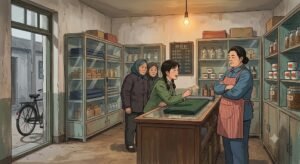
The 供销社 was the only legal store in rural China — a state-owned cooperative that was the sole outlet for daily necessities: salt, matches, kerosene, fabric, needles and thread, soap, cigarettes, and basic farm tools. There were no private shops. The clerk behind the counter had enormous informal power — deciding who got the best fabric, who got the scarce goods when supply was low.
In 年代文, a position at the 供销社 is considered an elite job. The heroine who befriends (or becomes) the 供销社 clerk gains access to goods others can’t obtain. The store is also a social hub — a place where gossip is exchanged, alliances are formed, and deals are made under the counter.
The Rationing System — Tickets for Everything
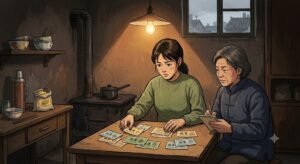
Nothing illustrates the scarcity economy of this era better than its elaborate system of ration coupons. In 年代文, characters treat these tickets like modern currency because they functionally were.
| Coupon Type | Chinese | Pinyin | What It Bought |
|---|---|---|---|
| Grain coupon | 粮票 | liángpiào | Rice, flour, grain — the most essential |
| Oil coupon | 油票 | yóupiào | Cooking oil (rationed to a few ounces/month) |
| Cloth coupon | 布票 | bùpiào | Fabric for clothing |
| Sugar coupon | 糖票 | tángpiào | Sugar |
| Soap coupon | 肥皂票 | féizào piào | Soap |
| Meat coupon | 肉票 | ròupiào | Pork (extremely scarce in villages) |
| Bicycle coupon | 自行车票 | zìxíngchē piào | Required to purchase a bicycle |
粮票 (liángpiào) were the most critical. Urban residents had urban grain coupons (城镇粮票); rural residents received grain directly from the production team’s collective harvest — which is why educated youth, stripped of their urban coupons when sent to the countryside, were utterly dependent on their work points.
黑市 (hēishì) — Black market. Despite the risks, a gray/black market in coupons and goods always existed. Trading grain tickets for cloth tickets, or exchanging city goods brought by visiting relatives for rural specialty food, was technically illegal but universally practiced.
走后门 (zǒu hòumén) — Literally “going through the back door.” Using personal connections to obtain goods, services, or opportunities outside official channels. An essential survival skill and a major 年代文 plot device.
Everyday Life Vocabulary
Housing
大院 (dàyuàn) — Compound. A walled residential complex, often housing families of workers from the same factory or unit, or military families. The 军区大院 (jūnqū dàyuàn) — military compound — is one of the most popular settings for 年代文, since it offers a more privileged and politically complex world than a rural village.
单位 (dānwèi) — Work unit. Your employer was your entire life — housing, food, medical care, childcare, marriage approval, travel permits, and political supervision were all administered through your danwei.
窑洞 (yáodòng) — Cave dwelling. Common in Shaanxi and Shanxi provinces; educated youth sent to the loess plateau often lived in these. Distinctive setting detail.
炕 (kàng) — Heated brick sleeping platform. Common in northern Chinese rural homes, heated from below by a cooking fire. Educated youth from southern cities found these deeply alien at first.
Coveted Possessions
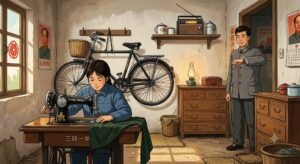
The ultimate status symbol package of the early 1970s was known as 三转一响 (sān zhuǎn yī xiǎng) — “three turns and one ring”:
- 缝纫机 (féngrèn jī) — Sewing machine (Singer-style treadle machine)
- 自行车 (zìxíngchē) — Bicycle
- 手表 (shǒubiǎo) — Wristwatch
- 收音机 (shōuyīn jī) — Radio
A family that owned all four was considered exceptionally well-off. In 年代文, these items are standard components of a bride price or dowry negotiation, and a heroine who arrives with a sewing machine has a serious social advantage.
的确良 (díquèliáng) — A type of polyester fabric (Dacron) that was enormously fashionable in the 1970s because it didn’t wrinkle and dried quickly — a luxury compared to cotton. Characters who wear 的确良 shirts are marking themselves as stylish and relatively well-connected.
解放鞋 (jiěfàng xié) — Liberation shoes. The ubiquitous green rubber-soled canvas shoes worn by soldiers and civilians alike. The standard footwear of the era.
Food
粗粮 (cūliáng) — Coarse grains: corn, sweet potato, sorghum, millet. The staple of rural and lean urban diets. Contrasted with 细粮 (xì liáng) — refined grain: white rice and white flour, which were precious.
红薯/地瓜 (hóngshǔ / dìguā) — Sweet potato. Appears on almost every page of a rural 年代文; the backup staple when grain rations ran low.
玉米面 (yùmǐ miàn) — Cornmeal. Made into porridge (粥), flatbread (饼), or steamed buns. Educated youth who arrived unable to digest coarse grain are a comic and poignant trope.
窝窝头 (wōwotou) — Steamed corn buns. Rough and dense, the food of poverty. To eat 窝窝头 and claim it tastes good is the ultimate act of ideological performance.
票证 (piàozhèng) — Ration coupons (collective term). “没有票证” — “without ration coupons” — is a state of genuine crisis.
Communications
公共汽车 (gōnggòng qìchē) — Public bus (the only transportation for most people).
电报 (diànbào) — Telegram. Urgent news was sent by telegram; receiving one was always alarming. In 年代文, a telegram about a sick parent is a classic plot catalyst to try to return to the city.
信 (xìn) — Letter. The primary means of communication between educated youth and their families. Mail was slow, sometimes censored, and deeply anticipated.
Revolutionary Culture & Objects
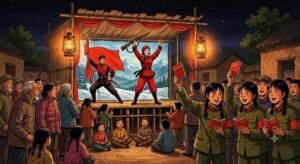
红宝书 / 毛主席语录 (hóng bǎo shū / Máo zhǔxí yǔlù) — The Little Red Book / Quotations from Chairman Mao Zedong. Carrying it, quoting from it, and waving it was obligatory public performance. Characters who can quote it fluently under pressure demonstrate political survival skill.
样板戏 (yàngbǎn xì) — Revolutionary Model Operas. Eight approved theatrical works (later expanded slightly) were the only entertainment permitted during the Cultural Revolution — works like The Red Detachment of Women (红色娘子军) and The White-Haired Girl (白毛女). These were performed constantly in villages. A heroine who can perform a sample role has a useful social skill.
毛主席像章 (Máo zhǔxí xiàngzhāng) — Mao badges/portrait pins. Worn on clothing as a sign of loyalty; collecting them became a fever during the Cultural Revolution. Characters give them as meaningful gifts.
忆苦思甜 (yì kǔ sī tián) — “Recall bitterness, think sweetly.” Political meetings where elderly peasants recounted their suffering under the “old society” (pre-revolution), designed to cultivate gratitude for the present. A ritualized form of collective memory that appears in many 年代文.
自我批评 (zìwǒ pīpíng) — Self-criticism. Writing or delivering a public statement confessing your political errors. A survival skill — the politically adept one is suitably contrite without admitting to anything that could be used against them later.
Web Novel Tropes — The Meta Layer

Now for the layer that makes 年代文 distinctly web novel rather than literary fiction. These genre conventions are as much a part of the reading experience as the historical content.
Protagonist Entry Points
重生 (chóngshēng) — Rebirth. A modern woman dies and is reborn as a character in the past, keeping her memories. The most common 年代文 setup. She knows what’s coming — the end of the Cultural Revolution, the opening of the gaokao, the economic reforms — and uses this knowledge to protect her family and thrive.
穿越 (chuānyuè) — Transmigration/time travel. A modern woman is transported into the body of a character in a period novel or historical era. Slightly different flavor from rebirth — she’s inhabiting someone else’s life, often someone who had it terrible.
穿书 (chuān shū) — Transmigrating into a book. The heroine wakes up inside a 年代文 she was reading, usually as the villainess or a cannon fodder character, and must avoid the original story’s bad ending.
Cheat Abilities (金手指 Jīn Shǒuzhǐ)
金手指 (jīn shǒuzhǐ) — Golden finger. The protagonist’s special cheat ability. Common ones include:
- 空间 (kōngjiān) — Pocket dimension / storage space. The heroine has access to a magical space — often described as containing a farm, spring, or warehouse — where she can secretly grow food, store goods, and hide modern conveniences. The ultimate cheat in a world of scarcity.
- 系统 (xìtǒng) — System. A game-like interface that gives the heroine tasks, rewards, and stat upgrades.
- 医术 (yīshù) — Medical knowledge. Being a doctor or nurse in a past life gives enormous advantages in a rural village with no healthcare.
- 厨艺 (chúyì) — Culinary skill. Being able to cook delicious food from limited ingredients is a surprisingly powerful social currency.
Character Archetypes
白莲花 (bái lián huā) — White lotus. The hypocritical antagonist — outwardly gentle and innocent, inwardly scheming and vicious. The “original” heroine of the novel the protagonist transmigrates into is often a 白莲花 who the protagonist must outmaneuver.
绿茶 (lǜ chá) — Green tea (b*tch). A manipulative woman who plays innocent and uses men. A more modern term that retroactively gets applied to period antagonists.
渣男 (zhā nán) — Scum man. The original love interest who abandons the original body owner. The 年代文 heroine in a rebirth story usually wants nothing to do with him.
炮灰 (pàohuī) — Cannon fodder. The role the protagonist was originally cast as in the story’s universe — doomed to be sacrificed for the main story’s progression. The entire point of 穿书 stories is to escape this fate.
军婚 (jūn hūn) — Military marriage. Marrying a soldier or military officer. One of the most popular 年代文 sub-genres because military families had better food, housing, and social status, and military husbands are often written as steadfast protectors. The law protecting military marriages (军婚保护) meant that attempting to destroy such a marriage was an actual crime — useful plot armor.
Common Plot Beats to Expect
- Heroine arrives in the countryside and is immediately either freezing, starving, or ambushed by someone trying to steal her grain ration
- Discovery of a hidden talent (medical, accounting, craftsmanship) that makes her invaluable to the production team
- Navigating whether to “扎根” (take root) or scheme for return to the city
- A rival educated youth or local villain threatening her political safety
- A gradual romance with either a local cadre’s son, a military man passing through, or a fellow educated youth with a hidden prestigious family background
- Working toward a life-changing goal: 招工 (factory recruitment), 推荐上大学 (university recommendation), or simply surviving until 1977 — the year the 高考 (gaokao) university entrance exam was reinstated after the Cultural Revolution, throwing open doors to anyone who could pass
Quick Reference Glossary
A condensed cheat sheet for reading:
| Term | Pinyin | Meaning |
|---|---|---|
| 年代文 | niándài wén | “Era fiction” — the genre itself |
| 知青 | zhīqīng | Educated Youth (sent-down urban youth) |
| 下乡 | xià xiāng | Going to/being sent to the countryside |
| 供销社 | gōngxiāoshè | Supply and Marketing Cooperative (the only store) |
| 生产队 | shēngchǎn duì | Production Team (basic labor unit) |
| 大队 | dàduì | Production Brigade (village level) |
| 公社 | gōngshè | People’s Commune (township level) |
| 工分 | gōngfēn | Work points (labor currency) |
| 粮票 | liángpiào | Grain ration coupon |
| 布票 | bùpiào | Cloth ration coupon |
| 成分 | chéngfèn | Class background/status |
| 根红苗正 | gēn hóng miáo zhèng | Revolutionary-pure family background |
| 批斗会 | pīdòu huì | Struggle session (political denunciation meeting) |
| 大字报 | dàzìbào | Big-character poster |
| 帽子 | màozi | Political label (“hat”) |
| 走后门 | zǒu hòumén | Using backdoor connections |
| 黑市 | hēishì | Black market |
| 招工 | zhāo gōng | Factory worker recruitment (path out of countryside) |
| 回城 | huí chéng | Return to the city |
| 户口 | hùkǒu | Household registration (urban vs. rural) |
| 介绍信 | jièshào xìn | Letter of introduction (required for travel) |
| 干部 | gànbù | Cadre, official |
| 三转一响 | sān zhuǎn yī xiǎng | The four status symbols: sewing machine, bicycle, watch, radio |
| 的确良 | díquèliáng | Dacron polyester fabric (fashionable) |
| 重生 | chóngshēng | Rebirth (protagonist trope) |
| 穿越 | chuānyuè | Time travel/transmigration (protagonist trope) |
| 空间 | kōngjiān | Pocket dimension (common cheat ability) |
| 金手指 | jīn shǒuzhǐ | Golden finger (cheat ability) |
| 军婚 | jūn hūn | Military marriage |
| 炮灰 | pàohuī | Cannon fodder (role protagonist usually escapes) |
| 白莲花 | bái lián huā | White lotus (hypocritical antagonist) |
| 高考 | gāokǎo | University entrance exam (reinstated 1977) |
A Final Note: Reading Between the Lines
The best 年代文 authors walk a careful line. The genre exists in a politically sensitive space — too much explicit condemnation of Mao-era policy could get a novel removed from platforms. This means readers need to learn to read subtext. When a heroine silently endures a struggle session against her father, the reader understands the condemnation even without editorial comment. When a character reflects that “those were simpler times” with gentle irony, the author is doing something sophisticated.
The best 年代文 aren’t just escapist fantasy (though they are gloriously that too). They are a way for Chinese readers — especially those whose grandparents lived these experiences but rarely spoke of them — to reckon with a difficult history through the safe distance of genre fiction. The clever heroine who feeds her whole village using her “space” is, at another level, a fantasy of what it would have meant to have enough — enough food, enough safety, enough power to protect the people you love from a system designed to grind them down.
That makes even the fluffiest 年代文 worth reading carefully.
Now go find your next novel. The 生产队 awaits.
Happy reading!


